
The 7 Best StoryGraph Alternative Apps in 2026
Seven book tracking apps for readers who want more privacy, more community, or a daily habit instead of a dashboard.
The StoryGraph is the app most readers moved to when they left Goodreads, and for mood-based discovery it's still hard to beat. But missing books, dense data and a small community send plenty of readers looking again. Here's how to take your StoryGraph library with you, which apps import it directly, and an honest look at seven alternatives, including what each does better and worse than The StoryGraph.
Last reviewed
Why Readers Look Beyond The StoryGraph
The StoryGraph earned its reputation. Its mood and pace tags let you search for "dark, emotional, medium-paced" instead of just a genre, its stats pages are the most detailed of any tracker, it rates in quarter stars, and most of it is free. StoryGraph Plus, at $49.99 a year, adds custom charts, extra filters and year-on-year comparisons. If you left Goodreads for it, you probably don't regret it.
But the reasons readers look further are consistent. Its book database has gaps, especially for less popular titles, and importing by ISBN doesn't always find a match. Some readers report pages that hang or fail to load in the app. The data density that analytical readers love is more than casual trackers want. Its community is smaller than Goodreads', so reviews are thinner on anything outside the bestsellers. And some readers simply want something different: more private, more social, or a daily habit tracker rather than an analytics dashboard.
Before You Switch: Take Your StoryGraph Data With You
Your history comes with you. On the StoryGraph website, open the menu, go to Manage Account, scroll to Manage Your Data and click Export StoryGraph Library. You get a CSV with every book, your ratings (quarter stars included), reviews, tags, moods and reading dates.
Hardcover, Literal and BookWyrm import that StoryGraph file directly. Parch and most other apps import a Goodreads export, so if you still have your old Goodreads account, that's the easy route: export it from My Books → Import and Export, and it brings everything you logged before StoryGraph. Either way, keep your StoryGraph account for a few weeks until you've checked everything came across.
Quick Picks: Which StoryGraph Alternative Is Right for You?
Want a private daily habit, with streaks, reading sessions and ratings finer than quarter stars? Parch. Liked StoryGraph's independent spirit and want a bigger social side? Hardcover. Reading is social for you? Fable.
Motivated by timers and pace predictions? Bookly. Want a quiet shelf with good notes and highlights on iPhone? Literal. Want open source? BookWyrm for a social network no company owns, or Openreads for a tracker with no account at all.
Parch: Best for a Private Daily Reading Habit
Where The StoryGraph is an analytics dashboard, Parch is a daily companion. Logging a session takes seconds, a timer tracks pages for print and minutes for audiobooks with equal weight, and streaks and flexible goals (books, pages, time or listening) keep you coming back. Your pace and an estimated finish date come from your own sessions, and with Premium a reading guide paces a book to the date you choose and tells you whether you're on track. Notes and quotes live on each book (scan text straight from a page), a monthly calendar view shows every day you read, and you can share a session's stats, a review, your month or your year as a card. There's no feed, no followers and no ads: your reading log is private by default.
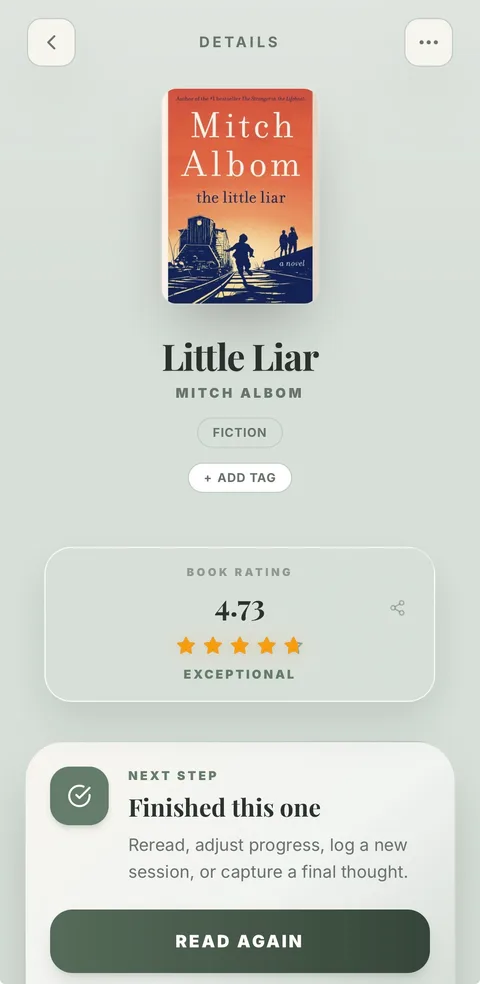
Ratings are the one place Parch is more precise than The StoryGraph. StoryGraph stops at quarter stars; Parch rates to two decimal places, so a book that's a 4.73 in your head can be a 4.73 in your library. Shelves include on hold and did not finish, custom tags let you organize however you like, and you can back up your whole library (books, collections and goals) to a file and restore it in Parch any time.
What it doesn't do: Parch has no mood and pace tags, content warnings or algorithmic recommendations, which are The StoryGraph's core strengths. It doesn't import StoryGraph's export file yet, so bring your history in with a Goodreads export, which it imports in one step: shelves, ratings, read dates, reviews, private notes and reread counts, with custom shelves turned into tags. It's on iPhone and Android, with no web version yet, so if you mostly use The StoryGraph in a browser, Parch is a change of habit.
Hardcover: Best for StoryGraph's Spirit With More Community
Hardcover is a natural next step for StoryGraph users: it's independent too, built by a small team led by founder Adam Fortuna, with a public roadmap and open books on how it's funded. It leans further into community than The StoryGraph, with reviews, shareable lists, trending books and a feed of what friends are reading. Its extras include privacy settings per book and series tracking that flags books you've missed and ones still to come, plus a Did Not Finish status and a year-end recap.
It imports your StoryGraph export directly, as well as Goodreads, and it's on the web, iPhone and Android. The core app is free, with an optional Supporter membership. Two trade-offs for StoryGraph users: ratings go to half stars, not quarters, and there's nothing like StoryGraph's mood-based search.
Fable: Best for Book Clubs and Social Reading
If what you miss on The StoryGraph is people, Fable is the answer. It's built around book clubs, including clubs run by BookTok and YouTube creators, buddy reads with friends, and discussions pinned to chapters so nobody gets spoiled. It has half-star ratings and imports your Goodreads history. Fable is also an e-reader: it sells ebooks, and when you read one in the app you can highlight, add notes, react and comment inside the book itself, alongside your club.
The free app carries ads; Fable Plus removes them and adds advanced stats and custom goals, and some premium clubs charge their own fee. Its stats are lighter than StoryGraph's, so analytical readers may miss the charts. It's on iPhone and Android.
Bookly: Best for Timed Sessions and Pace Predictions
Bookly measures reading rather than describing books. Start a timed session and it tracks your pace, predicts when you'll finish each book and awards achievements along the way, with detailed statistics on top. It supports half-star ratings and imports from Goodreads, on iPhone and Android.
The free version limits how many books you can add, and Bookly Pro lifts the limit and unlocks the full stats. Readers who find timers stressful should look elsewhere.
Literal: Best for a Quiet Shelf With Notes and Highlights
Literal is the calm option: a clean shelf, book clubs, progress by pages, percentage or minutes, and highlights you can capture by photographing the page. Recommendations come from people rather than algorithms. It imports your StoryGraph export directly, as well as Goodreads.
The catch is platforms. Literal was removed from Google Play in February 2025, so it's web and iPhone only.
BookWyrm and Openreads: Best Open-Source Options
BookWyrm is an open-source, decentralized social network for readers: independently run servers that connect with each other and with Mastodon, so people there can follow your reviews. It's ad-free by design and imports from The StoryGraph, Goodreads, LibraryThing, Open Library and Calibre. You'll need to pick a server to join, and the communities are small.
Openreads is an open-source tracker for iPhone and Android with no account at all. It works offline, has no ads or tracking, keeps your library on your phone and rates in half stars. It imports Goodreads CSVs, so bring your old Goodreads export if you have one. There's no social side, and backups are up to you.
Should You Just Stay on The StoryGraph?
Maybe. If mood-based recommendations are the reason you use it, nothing on this list matches them, and switching would lose the thing you value most. Plenty of readers split the job instead: they keep The StoryGraph for discovery, browsing books by mood and pace, and use a second app for daily tracking. Nothing stops you running both.
Switch outright if what's bothering you is the core experience: the missing books, the density, the lack of community, or the feeling that you're managing a spreadsheet rather than building a reading habit. That's the gap every app above is trying to fill, each in its own direction.
At a Glance
| App | Best for | Ratings | Imports from |
|---|---|---|---|
| The StoryGraph | Mood-based discovery & deep stats | Quarter stars | Goodreads |
| Parch | Reading sessions & finishing books | Two decimal places | Goodreads |
| Hardcover | Indie app with more community | Half stars | StoryGraph, Goodreads |
| Fable | Book clubs | Half stars | Goodreads |
| Bookly | Timed sessions & pace | Half stars | Goodreads |
| Literal | Quiet shelf & highlights | Half stars | StoryGraph, Goodreads |
| BookWyrm | Open-source social reading | Stars | StoryGraph, Goodreads, LibraryThing + |
| Openreads | Private, no-account tracking | Half stars | Goodreads CSV |
“Imports from” lists the sources each app documents; any app can take your Goodreads export if you still have one. Features and paid tiers change, so check each app before you switch.
Frequently Asked Questions
What is the best StoryGraph alternative?
It depends on why you're leaving. For a private daily reading habit with streaks and ratings to two decimal places, Parch. For an independent app with more community, Hardcover. For book clubs, Fable. For timed sessions, Bookly. For open source, BookWyrm or Openreads.
Can I export my StoryGraph library?
Yes. On the StoryGraph website, go to Manage Account → Manage Your Data → Export StoryGraph Library. You get a CSV with your books, ratings, reviews, tags, moods and reading dates.
Which apps import StoryGraph data?
Hardcover, Literal and BookWyrm import a StoryGraph export directly. Parch and most other apps import a Goodreads export, so if you still have a Goodreads account, exporting from there is the easiest way to bring your history.
Is there an app with more precise ratings than The StoryGraph?
Yes. The StoryGraph rates in quarter stars; Parch rates to two decimal places, so you can give a book a 4.73 or a 4.92. Most other alternatives, including Hardcover, Fable and Bookly, stop at half stars.
Is The StoryGraph free?
Mostly. Tracking, mood and pace tags, recommendations and most stats are free. StoryGraph Plus costs $49.99 a year and adds custom charts, extra filters, year-on-year comparisons and the ability to vote on upcoming features.
Can I use The StoryGraph and another app together?
Yes, and many readers do: they keep The StoryGraph for browsing books by mood and pace, and use another app for daily tracking. Parch, for example, handles streaks, sessions and private notes, while The StoryGraph handles discovery.
Put this guide into practice
Time your reading sessions, keep a daily streak and see when you'll finish every book. Free on iPhone and Android.
The 2026 Reading Journal Kit
Six printable pages to log, plan and celebrate your reading year. Enter your email and we'll send the PDF straight to your inbox.
- Reading log
- TBR planner
- Monthly tracker
- Ratings & reviews
- Reading bingo
- Year in books