
How to Read Faster (Without Losing Comprehension)
What the research says actually raises your reading speed, what's just marketing, and the easier way to read more.
Most people can read somewhat faster than they do, but not the way speed-reading courses promise. The most thorough review of the research, published in 2016, found no shortcut that raises speed without costing comprehension. Here's what does help, what doesn't, why 1,000 words a minute is skimming, and why, if your real goal is to read more books, a few extra minutes a day beats any technique.
Last reviewed
First, Measure Your Baseline
Before changing anything, find out how fast you read now. In a 2019 analysis of 190 studies, Marc Brysbaert put the average adult's silent reading speed in English at about 238 words per minute for non-fiction and 260 for fiction, but the only number that matters is yours. Our free reading speed test takes two minutes and checks your comprehension too.
A baseline does two things. It makes progress visible (re-test in a month), and it protects you from speed-reading hype, because you'll be able to tell reading faster apart from simply skimming.
The Biggest Lever: Language Skill, Built by Reading More
In 2016 a team led by the eye-movement researcher Keith Rayner reviewed decades of studies for the journal Psychological Science in the Public Interest, in a paper titled "So Much to Read, So Little Time." Their conclusion was blunt: there's no magic technique. What separates fast, fluent readers from slow ones is mostly language skill: a large vocabulary and a feel for how sentences are built, so that words are recognized instantly and meaning comes without effort.
The way to build that is unglamorous and free: read more, and read widely. It's why a lifelong reader breezes through a novel while a reluctant reader labors over the same page. Twenty minutes a day over months does more for your speed than any weekend course, and the gains come with full comprehension.
What Your Eyes Can and Can't Do
When you read, your eyes don't glide along the line. They jump, pausing for roughly a quarter of a second at a time, and in each pause you clearly identify about one word, sometimes two. You do pick up a little from the letters to the right, which helps you plan the next jump, but that window is narrow and set by how sharp vision is outside its centre.
This is why the classic speed-reading promise, training yourself to take in whole lines or "see" three or four words at a glance, doesn't hold up. The 2016 review found no good evidence that such training widens what you can see; people who appear to do it are reading less of the text. It's also why claims of 1,000 words a minute with full comprehension don't survive testing: at that pace you're sampling the page, not reading it.
Re-Reading: Less Than You Think, and Not All Bad
Speed-reading courses treat regression, your eyes jumping back to earlier words, as a bad habit to stamp out. In skilled readers it's a minority of eye movements, and many of them do real work: rechecking a word you misread or untangling a sentence that turned out to mean something else. In a 2014 study by Elizabeth Schotter and colleagues, readers who were prevented from going back understood tricky sentences less well.
Re-reading that comes from drifting attention is worth reducing, and that's where a pacer can help: running a finger or pen under the line can keep your attention moving forward. Treat it as a focus aid to try, not a guaranteed speed boost, and don't fight the glances back that help you understand.
Understand Subvocalization (and Don't Try to Kill It)
Subvocalization is the inner voice that "says" words in your head as you read. Speed-reading programs love to call it the enemy: eliminate it, they claim, and you'll read at the speed of sight. This is where the field tips from technique into myth.
Inner speech is part of how skilled reading works, and it helps you hold words in mind long enough to understand a sentence, especially a complex one. It quiets on its own on easy, familiar material as you get more fluent. Trying to silence it altogether is how speed reading turns into fast skimming with poor recall.
What About Speed-Reading Apps?
Many apps flash one word at a time in the same spot on the screen, at whatever speed you set, so your eyes never have to move. It feels fast. The 2016 review found that comprehension drops as the speed goes up, partly because you can't glance back to fix a misunderstanding and the words keep coming whether you've understood them or not.
They can be fun for short, simple text. For a book you want to remember, they mostly trade understanding for a bigger number.
Fix Your Environment and Focus
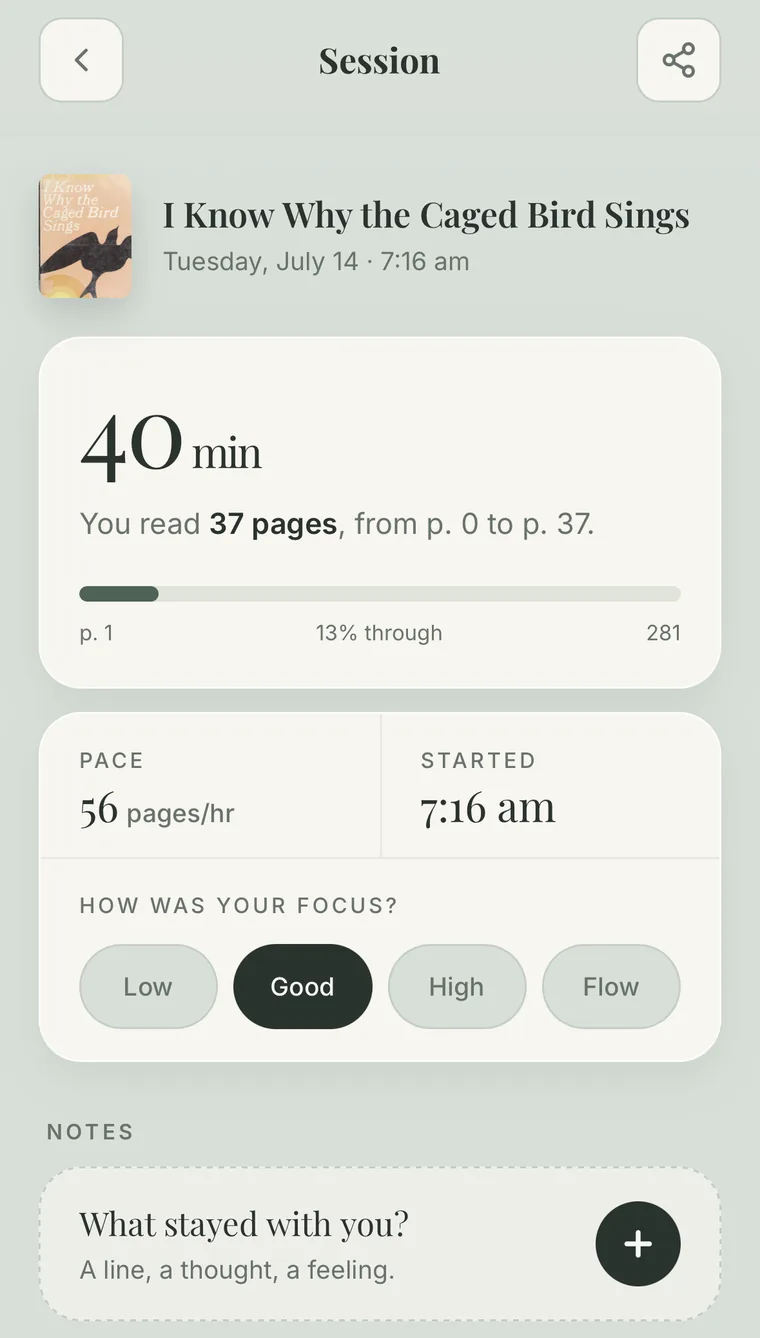
A surprising amount of slow reading is distracted reading. Every time your attention drifts, to a notification, a stray thought or background noise, you lose your place and have to find it again. Reading in a quiet space with your phone in another room can raise your effective speed more than any eye-movement drill, simply by removing the restarts. Parch asks how your focus was at the end of each session (low, good, high or flow), which makes it easier to notice the times and places where you read best.
Match the book to your energy, too. Pushing through dense material when you're tired guarantees slow, stop-start reading. Save demanding books for when your focus is sharpest, and lighter ones for when it isn't.
Want to Read More Books? Time Beats Speed
For most people the real goal isn't a higher number on a speed test; it's getting through more books. Here the maths is clear. Going from 250 to 300 words per minute, a hard-won improvement, lets you read 20% more. If you read for 30 minutes a day, six more minutes does exactly the same, with no technique to learn and no risk to comprehension.
So protect the time first. Our guides to building a daily reading habit and reading 100 books a year show how a few minutes a day adds up. Parch helps here too: time your sessions and it shows your pace in pages per hour and when you'll finish the book you're on, so you can see the difference a little extra time makes.
Listen Faster, Too
If you listen to audiobooks, playback speed is the one place a simple setting really does let you get through books faster. Narration usually runs at 150 to 160 words a minute, slower than most people read, so many listeners settle between 1.2x and 1.8x; at about 1.5x you're covering ground at roughly an average reading pace.
Comprehension holds up well at moderate speed-ups and falls off as you push further, so raise it in small steps. Our guide to the best audiobook speed has the method, and listening time counts as reading in Parch.
Know When Not to Read Faster
Speed is a tool, not a virtue. The goal is the right pace for the material and your purpose: quick through a breezy thriller, slower through a poem or an argument you want to absorb. Skilled readers change pace constantly, and skimming has its place, for previewing a book or finding a fact, as long as you know that's what you're doing.
Use a faster pace where it adds value, and slow down, guilt-free, for the books that reward it. That flexibility, not raw words per minute, is what makes a good reader.
At a Glance
| Reading speed | Words per minute | What it's good for |
|---|---|---|
| Slow / careful | Under 200 WPM | Dense non-fiction, poetry, a second language, study |
| Typical adult | About 200 to 300 WPM | Most pleasure reading; the average is about 238 for non-fiction and 260 for fiction |
| Fast | 300 to 450 WPM | Light, familiar material; strong lifelong readers |
| Skimming | 500+ WPM | Previewing or finding a fact, not full comprehension |
Averages from Brysbaert's 2019 analysis of silent reading in English. Claims of 1,000+ WPM with full comprehension don't survive testing; at that pace you're skimming, not reading.
Frequently Asked Questions
What is a good reading speed?
The average adult reads about 238 words per minute for non-fiction and 260 for fiction, according to a 2019 analysis of 190 studies, so anywhere around 200 to 300 is normal. What counts as good depends on comprehension: a slower pace with full understanding beats a fast one you don't retain.
Can you really read 1,000 words per minute?
Not with genuine comprehension. In each pause your eyes clearly take in about a word, sometimes two, so at 1,000+ words a minute you're sampling the page rather than reading it. That's useful for previewing or finding a fact, but not for absorbing a book.
Does speed reading hurt comprehension?
Usually, yes. A 2016 review of the research found a trade-off: techniques that push speed well above your natural pace cost understanding. What raises speed without that cost is slower to build: a bigger vocabulary and more reading practice, plus fewer distractions.
Do speed-reading apps work?
Apps that flash one word at a time feel fast, but comprehension drops as the speed goes up, partly because you can't glance back to fix a misunderstanding. They're fine for short, simple text, not for books you want to remember.
How do I stop subvocalizing?
You don't need to. Inner speech supports comprehension, especially for complex text, and it quiets on its own on easy, familiar material as you become more fluent. Trying to silence it completely tends to turn reading into skimming.
What's the fastest way to read more books?
Read for a little longer rather than trying to read faster. Going from 250 to 300 words a minute is 20% more reading; if you read 30 minutes a day, six extra minutes does the same. For lasting speed, read more and more widely, and cut distractions.
Put this guide into practice
Time your reading sessions, keep a daily streak and see when you'll finish every book. Free on iPhone and Android.
Read More in 7 Days
One short email a day, one small habit that makes reading easier to keep up. Plus a printable 30-day streak tracker with your daily target on it.
- Day 1Start smaller than you think
- Day 2Tie reading to something you already do
- Day 3Close the gap between books
- Day 4Yes, audiobooks count
- Day 5Quit the book that's stopping you
- Day 6Never miss twice
- Day 7Look back, then set next month's target
- By Dec 31
- about 5 more books
- Every year
- 24 books