
How Long Will Your TBR Take?
A TBR calculator that counts the books you keep adding, and a system for a to-be-read list that never stops growing.
Every reader with a to-be-read list has wondered how long it would take to get through it. Most TBR calculators answer by assuming you'll stop adding books, which no reader does. This one doesn't. Put in your list, your pace and how often you add books, and you'll see whether your TBR is ever going to shrink. Below it: why the answer depends more on what you add than how fast you read, and a simple system for keeping a growing list useful rather than overwhelming.
TBR calculator
Unlike most TBR calculators, this one counts the books you keep adding.
Average is about 250 WPM. Measure yours in two minutes.
At this rate
Your TBR never shrinks
- You finish about 2.4 books a month (28 a year), and your list holds 770 hours of reading.
- You add 3 a month, so the list grows or holds steady. To start shrinking it, read more than 38 minutes a day, or add no more than 2 a month.
- Reading in the order you added them, the book you add today waits about 4 years 3 months.
Assumes about 275 words per page and a month of 30.44 days. Real reading varies: dense books take longer, and nobody reads every day, so treat this as a direction rather than a deadline.
Your TBR Is a Queue, Not a Pile
A pile only ever gets smaller. A to-be-read list behaves more like a queue at a shop: books leave from the front as you finish them and join at the back every time a recommendation lands. How long the queue takes to clear depends on two rates, how fast books leave and how fast they arrive, and the second is the one most readers forget.
Here's a typical list worked through. Say you have 120 books averaging 350 pages, you read at an average 250 words per minute, and you manage 30 minutes a day. At roughly 275 words a page, each book takes about six and a half hours, so you finish about 2.4 books a month, or 28 a year. That's already twice the American average: in Pew Research Center's 2021 survey, adults read a mean of 14 books a year and a median of just five. A long TBR is not a sign you read too little.
If you stopped adding books today, that list would take about four years and three months. Add one book a month and it's about seven years and three months. Add two and it's about 27 years. Add three, a modest number for anyone who follows BookTok or a couple of newsletters, and the list never shrinks at all.
Why Adding Fewer Books Beats Reading Faster
The obvious fix is to read more, and it helps less than you'd think. In the example above, speeding up from 250 to 300 words per minute takes you from about 2.4 to 2.8 books a month. Reading 40 minutes a day instead of 30 gets you to about 3.2. Both are real improvements, and neither rescues a list that grows by three books a month.
Going from two additions a month to one does more than both, cutting the example from 27 years to seven. The rate you add books is the only number that decides whether a TBR ever shrinks. That's not an argument for adding nothing, which would take the fun out of it. It's an argument for being choosy at the door, and for the system below.
Split Your TBR into Two Lists
The single most useful change is to stop keeping one list. Keep a master list, an open-ended archive of everything that has caught your eye, and an active TBR of just three to five books you actually plan to read next. When you choose your next book, you only look at the active list, which ends decision paralysis on the spot.
Only the active list is a queue you're working through; the master list is a catalogue you shop from. That distinction takes the sting out of the maths above, because a master list can grow forever without costing you anything. A list of 300 books only weighs on you when it feels like 300 promises.
Capture Every Recommendation in One Place
TBR anxiety often starts with scattered capture: titles in a notes app, screenshots of posts, a friend's text you'll never find again. Pick one inbox and send every recommendation there as soon as you hear it. The best inbox is the app you already track your reading in, so your wishlist and your library live together.
One place also gives you an honest count. You can't know how many books you add a month if half of them live in screenshots, and without that number any TBR forecast is guesswork.
Organize by Mood, Not Alphabet
When you finish a book, you don't think "what starts with D?" You think "I want something cozy" or "I'm ready for something heavy." Tag your master list to match: cozy, gripping, brainy, short, seasonal. Five to eight mood tags beat any elaborate genre system.
It turns the eternal "what next?" into a quick filter, and it makes the master list browsable the way your brain actually shops for books.
Adopt a One-Year Expiration Rule
If a book has sat on your master list for over a year and you've never once felt the pull to start it, delete it. Your tastes have moved on, and the person who added it isn't quite the person choosing now. If it's truly meant for you, it will cross your path again.
Pruning is also the quickest way to shorten the wait. In the example above, with one book added a month, deleting a fifth of the list cuts the time to clear it from about seven years and three months to about five years and ten months. Once or twice a year, spend ten minutes deleting what's expired and promoting what excites you.
There's a Word for This, and It Isn't an Insult
Japanese has a word for buying books and letting them pile up unread: tsundoku, from tsumu, to pile up, and doku, to read. It appeared in print around 1880, in a satirical description of a teacher with a large library he hadn't read, and in Japanese it doesn't carry much sense of waste.
Worth remembering when the calculator gives you a number in decades. A long list of books you'd like to read is a record of curiosity, not a debt. The only books you owe anything to are the few on your active list.
Protect the Queue from Shiny New Books
New releases and viral recommendations will always jump the line if you let them, and perpetual line-jumping is why some books sit on a TBR for a decade. A simple compromise: alternate. One book from the front of the queue, then one wildcard, then back to the queue.
You keep the joy of impulse reads without the backlog setting like concrete. And if a queue book keeps getting skipped, that's your answer: it doesn't belong on the active list.
Frequently Asked Questions
How long will it take to read my TBR?
Multiply your number of books by their average page count and by about 275 words a page, then divide by your reading speed to get total minutes, and compare that with how much you read each day. Then account for the books you add: if you add books faster than you finish them, the list never clears. The calculator on this page does all of it for you.
How many books does the average person read a year?
In Pew Research Center's 2021 survey of American adults, the mean was 14 books a year and the median was five, and 23% hadn't read a book at all in the previous year. Readers with a long TBR are usually well above average already.
How many books should be on my TBR?
Keep your active TBR to three to five books, small enough that choosing is instant. The master list behind it can be as long as you like, as long as you treat it as an archive to shop from rather than a list of promises.
What is tsundoku?
Tsundoku is a Japanese word for buying books and letting them pile up unread, from tsumu (to pile up) and doku (to read). It dates from around 1880 and, in Japanese, doesn't carry much sense of waste.
Should I feel guilty about a huge TBR?
No. A big master list is a well-stocked personal bookshop, not a debt. Guilt only makes sense if every entry is a promise, and it isn't. The only books you've committed to are the three to five on your active list.
What's the best way to organize a TBR?
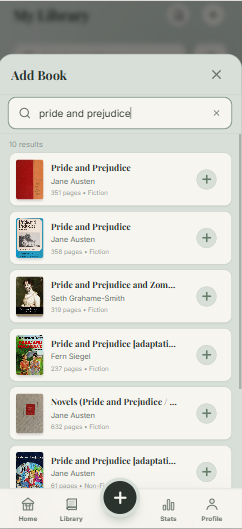
Keep it in the same place you track your reading, so a book moves from To Read to In Progress to Finished in one step. Split it into a short active list and a long master list, and tag the master list by mood. Parch handles all three, with covers, tags and sorting by page count.
Put this guide into practice
Time your reading sessions, keep a daily streak and see when you'll finish every book. Free on iPhone and Android.
The 2026 Reading Journal Kit
Six printable pages to log, plan and celebrate your reading year. Enter your email and we'll send the PDF straight to your inbox.
- Reading log
- TBR planner
- Monthly tracker
- Ratings & reviews
- Reading bingo
- Year in books