
How to Read 100 Books a Year
The real maths, a quarter-by-quarter plan, the habits that actually move the number, and an honest look at whether 100 is your goal.
Almost nobody reaches triple digits through willpower. They get there through arithmetic and a handful of habits: knowing the daily number, protecting two reading windows, letting audiobooks and short books count, always having the next book ready, and quitting bad ones without guilt. Here's the maths, a plan with checkpoints you can hold yourself to, and the case for aiming lower if 100 isn't really your number.
Last reviewed
The Real Maths of 100 Books
If an average book runs 300 pages, 100 books is 30,000 pages a year: 82 pages a day, every day. At a typical 250 words per minute that's about ninety minutes of reading daily, and closer to two hours on a slow day or with a dense book.
That's a genuine commitment, and worth saying plainly: it's a hobby-sized amount of time, not a life hack. The encouraging part is where the difficulty actually sits. Ninety minutes isn't one heroic session; it's two or three unremarkable ones. Nobody reaches 100 books by reading faster. They reach it by reading more often. The table at the end shows the daily time for every goal from 12 to 150, and the pages per day calculator works it out for your own goal and book lengths.
Is 100 Actually Your Number?
Before building a year around it, ask what the number is for. For context, in Pew Research Center's 2021 survey of American adults the median was five books a year. Twelve, one a month, already puts you well above the typical reader; 30 is exceptional; 52, a book a week, is a serious achievement.
Choose from the time you can give rather than a number that sounds impressive. About ten minutes a day is roughly 12 books a year, twenty minutes about 24, and forty-five minutes to an hour most days about 52. One hundred takes around ninety minutes every day.
Then weigh what you read for. One hundred books means roughly two a week, which quietly rules out long books, slow books and rereading, the things many readers love most. If you read to learn, a handful of non-fiction books read with notes will stay with you longer than thirty skimmed ones. If 100 doesn't make you want to open a book tonight, the 52 Book Challenge is a gentler target that still transforms a reading year. If it does, here's the plan.
A Plan for 100: Checkpoints, a Day and a Mix
Checkpoints first, because a yearly number is too far away to steer by. One hundred books is about two a week, which means roughly 25 by the end of March, 50 by the end of June and 75 by the end of September. Check in at each one. Being three books behind in April is a week of slightly longer evenings; discovering you're twenty behind in November isn't fixable.
A day that gets there: thirty minutes of print in the morning, thirty minutes of an audiobook on the commute or a walk at 1.5x, and thirty minutes of print in the evening. At 250 words a minute for reading and a typical narration pace sped up by half, that adds up to about 100 average-length books a year, without any single session longer than half an hour.
And a mix that makes it lighter. Suppose 35 of your hundred are audiobooks and 30 are short books of around 180 pages. Those 30 short books together run about as long as 18 average ones, and the audiobooks mostly fill time you couldn't read in anyway. A mix like that leaves far fewer than 100 average-length books for your eyes, which is what makes the daily time realistic.
Protect Two Windows
Readers who hit big numbers don't wait for free time to appear. They make reading the default for specific parts of the day. Choose your two most reliable windows, the ones that exist whether or not the day goes to plan: coffee before work, the commute, the half hour before sleep.
The evening slot pays a bonus. Swapping thirty minutes of scrolling for a printed book is also kinder to your sleep: in a small 2015 study published in PNAS, people who read on a light-emitting tablet before bed took nearly ten minutes longer to fall asleep than when they read a printed book.
Use Short Books Deliberately
This is the lever almost every article skips. A 150-page novel and a 600-page one both count as one book, but one takes an evening and the other a fortnight. Deliberately mixing in shorter books is the fastest honest way to raise your total without rushing anything.
It isn't cheating, either: some of the most admired books ever written are under 200 pages. Keep two or three in reserve, because finishing something is the reliable cure for a stalled month. Our list of short books under 300 pages is a good place to stock up.
Let Audiobooks Count
For most people who reach triple digits, audiobooks are the single biggest unlock: they turn commuting, cooking, walking and chores into reading time that didn't exist before. Thirty minutes of listening a day at 1.5x is about 30 average-length books a year on its own.
Narration runs slower than reading, around 150 to 160 words a minute, which is why most listeners settle between 1.2x and 1.8x; at about 1.5x you're covering ground at roughly your reading pace. Listening also holds up for understanding: in a 2016 study by Beth Rogowsky and colleagues, adults who listened to a passage of non-fiction understood it as well as those who read it. Dense or technical books can still go better in print, where you can slow down and reread. The audiobook speed calculator shows what your listening time is worth.
The trick that makes it work is switching formats within a book: the audiobook on the commute, the paperback at night. In Parch one book can be print, ebook and audiobook at once, each format keeps its own place, and listening minutes count as reading progress alongside pages.
Always Have the Next Book Ready
The gap between books is where reading years die. Finish something on a Sunday with nothing lined up, and Tuesday becomes Friday becomes a fortnight. The fix is unglamorous: keep a short list of what's next, and start the next book the same day you finish one, even if it's only a page.
Keep that list short. A TBR of four hundred titles is a museum, not a plan; three or four genuinely next-up books beat an infinite shelf you never choose from.
Read More Than One Book at a Time
One book rarely suits every mood or moment. A common setup is three: something absorbing for evenings, something lighter for tired days, and an audiobook for hands-busy time. When one stalls, you switch instead of stopping, which is what usually stops a slow week becoming a slow month.
If juggling several feels like chaos rather than choice, two is plenty. The point is having somewhere to go when a book isn't working tonight.
Quit Bad Books Quickly
Nothing costs a reading year more than the book you're not enjoying but feel obliged to finish. It stops you reading anything else, and the guilt tends to spread past the book itself.
Give a book fifty pages, or a hundred for something demanding you genuinely want to meet halfway. Then let it go. Abandoning a book is a decision about fit, not a verdict on the book or on you. Put it on a did-not-finish shelf, which Parch has, so the record stays honest and you don't pick it up again by accident.
Track the Pace, Not Just the Total
A yearly goal you can't see is a wish. Tracking turns it into a daily number and tells you early when you're drifting, at a checkpoint rather than in December. Set the daily goal in whatever unit fits how you read: pages, minutes or listening time, so an evening with a long book counts as fully as one with a short one.
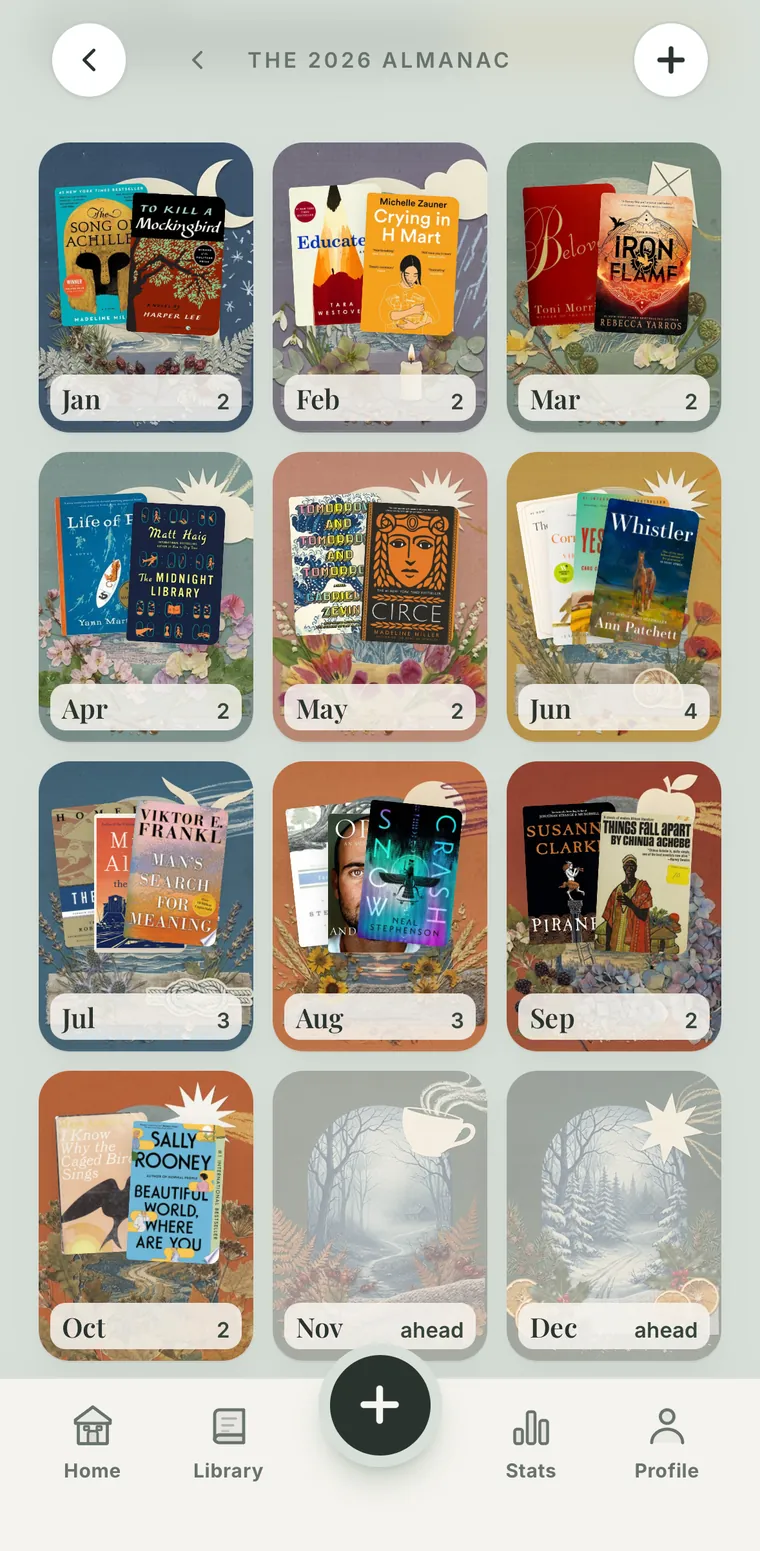
Parch is built for this. Time a session and it records the pages or minutes; after a couple of sessions it knows your pace and shows when you'll finish the book; a daily streak keeps the habit visible; and the monthly calendar shows which weeks went well. With Premium, the reading guide takes a finish date and the days you read and tells you whether you're on track, ahead or behind.
Over a year, the log also shows what the total never could: which months were good, which formats you actually finish, and what kind of book keeps you reading. That's the part worth keeping long after the number is forgotten.
At a Glance
| Books a year | Pages a day | Daily reading | What that looks like |
|---|---|---|---|
| 12 (one a month) | 10 pages | ~11 min | A chapter with your coffee |
| 24 (one a fortnight) | 20 pages | ~22 min | One commute |
| 52 (one a week) | 43 pages | ~47 min | A lunch break, or before bed |
| 75 | 62 pages | ~1 hr 8 min | Two solid sittings most days |
| 100 | 82 pages | ~1 hr 30 min | Reading is your main hobby |
| 150 | 123 pages | ~2 hr 15 min | Reading instead of most screens |
Assumes a 300-page average book and 250 words per minute. Audiobooks count: narration at about 1.5x runs close to an average reading pace, so an hour of listening covers similar ground.
Frequently Asked Questions
How many books should I read a year?
There's no right number. Start from the time you can give: about ten minutes a day is roughly 12 books a year, twenty minutes about 24, and forty-five minutes to an hour a book a week. For context, the typical American reads five books a year, so twelve already puts you well above average.
Is 12 books a year good?
Yes. Twelve books a year, one a month, is more than double the typical American's five, according to Pew Research Center's 2021 survey. It takes only about ten to fifteen minutes of reading a day.
How long does it take to read 100 books a year?
About ninety minutes a day, every day. That comes from 100 books at roughly 300 pages each, which is 30,000 pages or 82 pages a day, at an average 250 words per minute. Denser books push it past two hours; shorter books and audiobooks bring it down.
How many books should I have read by the middle of the year?
For 100 books, about 25 by the end of March, 50 by the end of June and 75 by the end of September, roughly two a week. For 52, it's one a week: 13, 26 and 39 at the same points.
Is reading 100 books a year realistic?
It's realistic if reading is one of your main hobbies and you have two or three protected windows most days, especially if audiobooks and short books are part of the mix. It isn't realistic squeezed around a full life with no changes. Plenty of committed readers land between 30 and 60 books a year, which is already well above average.
How many books does the average person read per year?
In Pew Research Center's 2021 survey of American adults, the median was five books a year and the mean 14, and 23% hadn't read any. That context matters: 30 books a year is exceptional and 52 a serious achievement. One hundred isn't the threshold for being a real reader.
Do audiobooks count toward a reading goal?
Count them. In a 2016 study, adults understood a non-fiction passage as well by listening as by reading, and audiobooks turn commutes and chores into reading time: thirty minutes a day at 1.5x is about 30 books a year. Parch counts listening minutes as reading progress, and one book can be print and audio at once.
Is it cheating to read short books to hit a goal?
No. Length reflects a writer's intention, not their ambition, and many of the most admired books ever written are under 200 pages. Deliberately mixing in shorter books is the fastest honest way to raise your total, and the most reliable way to break a stalled month.
The tools for this
Every lever above has something here to work it out with.
Put this guide into practice
Time your reading sessions, keep a daily streak and see when you'll finish every book. Free on iPhone and Android.
Read More in 7 Days
One short email a day, one small habit that makes reading easier to keep up. Plus a printable 30-day streak tracker with your daily target on it.
- Day 1Start smaller than you think
- Day 2Tie reading to something you already do
- Day 3Close the gap between books
- Day 4Yes, audiobooks count
- Day 5Quit the book that's stopping you
- Day 6Never miss twice
- Day 7Look back, then set next month's target
- By Dec 31
- about 5 more books
- Every year
- 24 books