
How to Build a Daily Reading Habit
What habit research says about making reading automatic, how to get through the first two weeks, and what a few minutes a day adds up to.
Consistency beats intensity. A few minutes every day adds up to more books than an occasional long session, and it's far more likely to last. Habit research gives a clear playbook: tie reading to a fixed moment, start smaller than feels reasonable, read something you actually want to get back to, make progress visible, and don't panic over missed days. Here's how, with a plan for your first two weeks and the numbers on what each daily habit adds up to over a year.
Last reviewed
How Much a Few Minutes a Day Adds Up To
Before choosing a daily target, see what each one is worth. At an average 250 words per minute, a 300-page book takes about five and a half hours. Ten minutes a day finishes about 11 of those a year; 20 minutes, about 22; 30 minutes, about 33. The table below has the full range, and the pages per day calculator works it out for your own goal.
The American median, according to Pew Research Center's 2021 survey, is five books a year. Ten minutes a day, about the length of one social media scroll, doubles it. If you're aiming much higher, our guide to reading 100 books a year has the plan; this one is about making the daily part stick.
Anchor Reading to Something You Already Do
The most reliable way to start a new habit is to attach it to an existing one with an if-then plan: "After I pour my morning coffee, I read ten pages," or "When I get into bed, I read until my timer goes off." Psychologists call these implementation intentions, and a 2006 meta-analysis of 94 studies by Peter Gollwitzer and Paschal Sheeran found they have a medium-to-large effect on actually following through.
The existing routine becomes the cue, so you don't depend on remembering or feeling motivated. Make the plan specific (a place, a time, a trigger) rather than "I'll read more." A timer helps more than it sounds: "ten minutes" is a promise you can keep on a bad day, and Parch's session timer records the time as it runs. With Premium, its reading guide can also remind you on the days you've said you'll read.
Remove the Friction
You read what's within reach. Leave the current book on your pillow so it's the last thing you see at night. Keep one in your bag. Put your e-reader app on your phone's home screen where a social app used to be.
Then add friction in the other direction: charge your phone across the room at night, and log out of the apps that eat your evenings. Your job is to make the book the easiest thing to reach for.
Start Smaller Than Feels Reasonable
The most common mistake is an ambitious daily quota. Thirty minutes a day sounds noble in January and collapses in February. Start with ten minutes or five pages, a floor low enough that your worst day still clears it.
Five pages a day is still more than 1,800 pages a year, around six books. Most nights you'll read past the minimum anyway; its only job is to get the book open. Raise the target only once the habit has survived a few bad weeks.
Let the floor be flexible about format. On a day with no time to sit down, ten minutes of an audiobook on a walk or while cooking counts. In Parch a daily goal can be pages, minutes or listening time, so a listening day keeps the streak as fully as a reading one.
Read Something You Want to Get Back To
New habits rarely die from lack of willpower. They die from the wrong book: something you feel you should read, that you dread opening, so you find reasons not to. For the first few weeks, choose for pull rather than prestige: a genre you already love, a favourite author, a reread, a thriller you'll want to finish. You can work up to the worthy books once reading is automatic.
Keep a short, easy book in reserve for the evening the main one stalls; our list of short books under 300 pages is a good place to find one. And if a book is making you avoid reading altogether, switch. Quitting one book to keep the habit is always the right trade, and our guide to getting out of a reading slump covers what to do when it's more than one book.
Put Reading First, and Make It a Treat
A rule like "one page before I open any app" or "book before TV" puts reading ahead of the things that swallow an evening, instead of after them. "I'll read after I check my phone" is how reading quietly never happens. You don't need to give up screens. You just need the book to come first.
Then make the habit something you look forward to. Behavioral scientists call it temptation bundling: in a 2014 study, Katherine Milkman and colleagues gave people gripping audiobooks they could only listen to at the gym, and they went to the gym more often. Turn it around for reading. Save the good tea, the favourite chair, the blanket or the quiet half hour after the kids are asleep for when the book is open, and the habit starts pulling you in instead of the other way round.
Make Progress Visible
Log your reading every day and watch the run of days grow. A 2016 meta-analysis of 138 experiments found that monitoring progress makes people more likely to reach their goals, especially when the progress is physically recorded, and a streak is the simplest record there is. Our guide to why tracking your reading works goes further into the research.
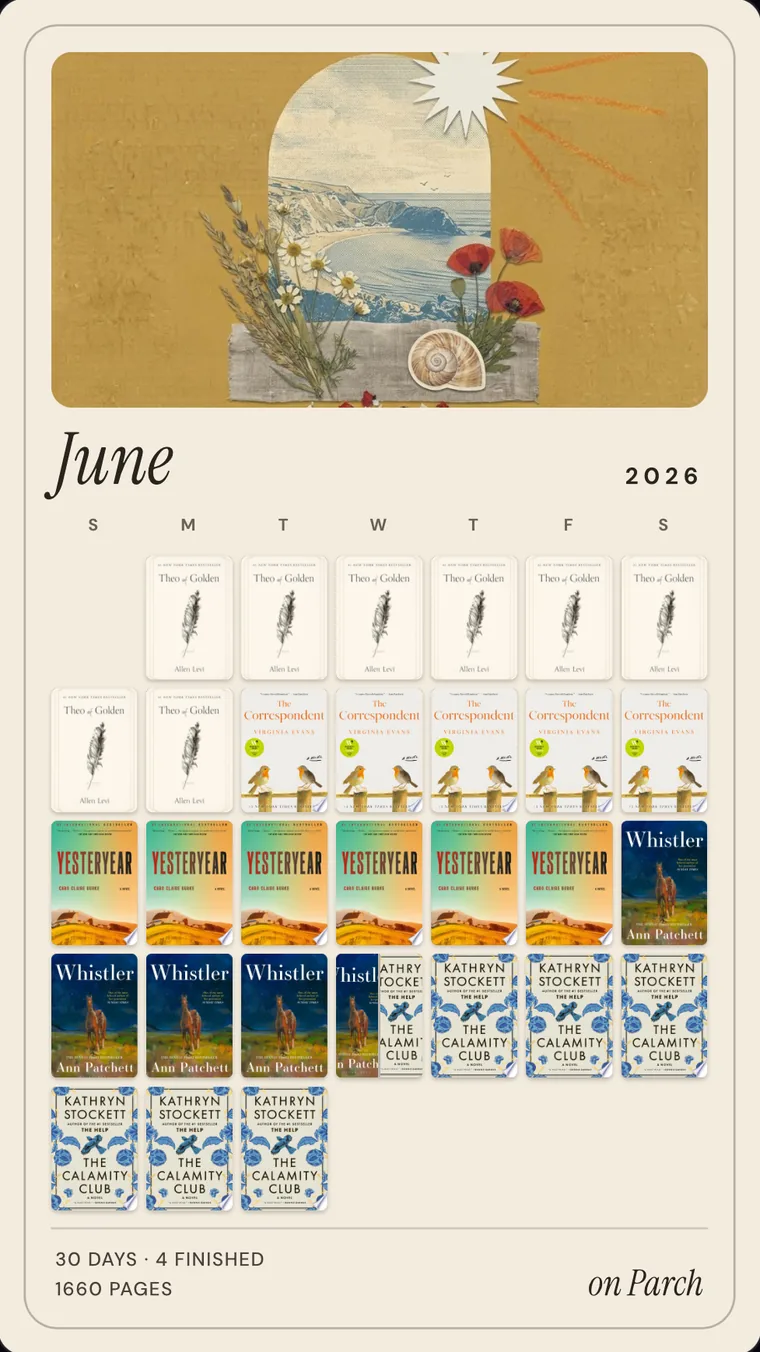
A tracker like Parch keeps the streak for you: log a session of any length and it lives on, and the monthly calendar shows every day you read, so a good fortnight is something you can see rather than something you have to remember. At the end of each session you can also note how your focus was, from low to flow, a quick way to spot which reading slot works best for you.
Expect Missed Days, and Don't Panic
Habits take longer to form than the popular "21 days" suggests. In Phillippa Lally's 2010 study at University College London, it took a median of 66 days for a new daily behavior to become automatic, with a range from 18 to 254 days. The same study found that missing a single day didn't materially set the process back.
So the rule that matters is simple: never miss twice. One missed day is noise; two in a row is the start of a different habit. Treat the lapse with zero drama, and on the next busy day, protect the streak with the smallest possible version: two pages, or ten minutes of listening.
Your First Two Weeks
Days 1 to 3: choose your cue and your book. Read five pages or ten minutes straight after the cue, and log it. Keep going if you want to, but the floor is all that counts.
Days 4 to 7: keep the same floor and the same cue. If the cue isn't working (you keep forgetting, or the moment keeps getting taken), move it now rather than pushing through. Finish the week by counting the days you read.
Days 8 to 14: add the treat, and if you like, a second, smaller cue such as an audiobook on the commute. Never miss twice. On day 14, look back: if you read on at least 12 of the 14 days, raise the floor a little. If not, make it smaller or move the cue, and give it another fortnight. Remember that 66 days is the median, so two good weeks is a beginning, not a finish line.
If you'd like this as a daily nudge, our free Read More in 7 Days course sends one short email a day, each with one small habit, plus a printable 30-day streak tracker with your daily target on it.
At a Glance
| Daily reading | Books a year | Pages a day (roughly) |
|---|---|---|
| 5 minutes | About 6 | 5 |
| 10 minutes | About 11 | 9 |
| 15 minutes | About 17 | 14 |
| 20 minutes | About 22 | 18 |
| 30 minutes | About 33 | 27 |
| 60 minutes | About 66 | 55 |
For 300-page books at 250 words per minute (about 275 words a page). Faster readers and shorter books go further; dense books less far.
Frequently Asked Questions
How can I read more books?
Read a little every day rather than a lot occasionally, and tie it to something you already do, like "after my morning coffee, I read ten pages." Ten minutes a day comes to about 11 books a year at an average pace, more than double the American median of five; the table above shows what 15, 20 or 30 minutes add up to.
How long does it take to build a reading habit?
Longer than 21 days. In a 2010 University College London study, new daily habits took a median of 66 days to become automatic, ranging from 18 to 254 days. Tying reading to a fixed daily cue, like morning coffee or bedtime, gives you the best chance.
How many minutes should I read a day?
Start with ten. At an average pace that's about 11 books of 300 pages a year, more than double the American median of five, and it's small enough to survive your busiest days. Increase it once the habit has held for a few weeks.
What if I miss a day?
Read the next day. Habit research found that missing a single day didn't materially set back habit formation. The rule to follow is never miss twice, and on busy days protect the streak with the smallest version: two pages, or ten minutes of an audiobook.
What should I read to build a reading habit?
Something you'll want to get back to: a genre you already love, a favourite author, a reread or a page-turner. Save the books you feel you should read until the habit is automatic, keep a short, easy book in reserve, and switch books rather than stop reading.
Do audiobooks count for a daily reading habit?
Yes. Listening keeps the habit alive on days with no time to sit down, like ten minutes on a walk or while cooking. Count it toward your daily goal; in Parch a goal can be pages, minutes or listening time.
Is it better to read every day or in long weekend sessions?
Daily. Frequency is what builds a habit, keeps the story fresh in your mind and survives a chaotic schedule. Long sessions are a bonus, not the foundation.
Put this guide into practice
Time your reading sessions, keep a daily streak and see when you'll finish every book. Free on iPhone and Android.
Read More in 7 Days
One short email a day, one small habit that makes reading easier to keep up. Plus a printable 30-day streak tracker with your daily target on it.
- Day 1Start smaller than you think
- Day 2Tie reading to something you already do
- Day 3Close the gap between books
- Day 4Yes, audiobooks count
- Day 5Quit the book that's stopping you
- Day 6Never miss twice
- Day 7Look back, then set next month's target
- By Dec 31
- about 5 more books
- Every year
- 24 books